|
The Truth Seeker
Tony Stone Matthew 7:7-8 Ask,
and it shall be given you. Seek, and you. shall find. Knock, and it shall be
opened unto you. For every one that asks receives. And he that seeks, finds.
And to him who knocks, it shall be opened. John 8:32 Then
you will know the truth, and the truth will set you free. Greg Koukl, on his Stand to Reason website, said, “I was doing some research on the death toll of religion versus Atheism. Statistics show that 20th century leaders such as Joseph Stalin, Mao Zedong and Pol Pot killed over 120 million people. Each of these leaders had clear orders to abolish religion as they wanted establish an Atheist state. Each leader started a purge against religious people.” The assertion is
that religion has caused most of the killing and bloodshed in the world. That
the greatest atrocities committed against man were done in the name of God.
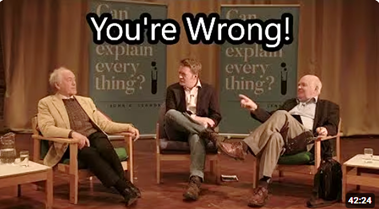
Wrong!! Communism is responsible for the greates
slaughter of people and is ongoing today in communist countries such as
China, particularly against the Uyghur people. John Lennox Calmly DISMANTLES
Remember: ·
Adolf Hitler was an atheist. He murdered millions. ·
Given the human aspect, science is not infallible.
Over time, science keeps correcting itself. ·
The Bible has not been proven wrong – yet. Even
after 2000 years. The Law of
Probability and statistical analysis has proven the
prophecies of the Bible unquestionably correct. Professor Stephen C Meyer, What Is Intelligent Design? Scientific PROOF of God Chloe said, Sunday is for mself,
What Jesus Christ said Jesus
said "But about that day or hour no one knows, not even the angels in
heaven, nor the Son, but the Father only" in Matthew 24:36 (KJV),
regarding the precise time of his return. However, He also stated in the same
passage, "Now learn this from the fig tree: When its branch has already
become tender and puts forth leaves, you know that summer is near. So you also, when you see all these things, know that
it is near—at the doors". This indicates believers are to recognize
the general season by observing the signs of the times, even if the exact day
or hour is unknown. Behold,
I come as a thief. Blessed is he that watcheth, and
keepeth his garments, lest he walk naked, and they
see his shame. Revelation
16:15
in the Bible, where the speaker (Jesus) warns believers to stay watchful
and prepared for his sudden return, symbolized by his coming "as a
thief". "Being found naked" signifies spiritual unreadiness,
shame, and exposure of one's spiritual poverty and failings when God judges.
Therefore, the blessing is for those who remain alert and spiritually
dressed, or prepared, lest they face the shame of their own spiritual
nakedness before God. |
Preamble To know
your future, you must understand your past Knowledge
and wisdom are closely tied together. knowledge tends to focus on the correct
understanding of the world, and oneself, as creatures of the world, while
wisdom is the acquired skill of applying that knowledge, effectively, in
every aspect of our daily lives. _____________________________________________________________________________________________________
Marcus
Aurelius was the last of the five good Roman emperors. He ruled from 161 CE
to 180 CE. He was a person who could endure pain or hardship without showing
his feelings or complaining. Besides his relative success in being a Roman
emperor, Marcus Aurelius may be best known as a Stoic philosopher and that he
truly attempted to live his philosophy. Aurelius became famous for “The
Meditations”, a collection of his thoughts, stoic beliefs, and notes on his
life. He
was a member of the Nerva–Antonine dynasty, the last of the of the Pax
Romana, an age of relative peace, calm, and stability for the Roman Empire
lasting from 27 BCE to 180 CE. His
teachings, which range from cultivating a positive mindset to finding joy in
the present moment, provide valuable lessons that are as relevant today as
they were thousands of years ago. These quotes are sure to inspire and
motivate you, whether you’re a seasoned philosopher or simply looking to live
a more mindful and purposeful life. So, let’s look at and discover Marcus
Aurelius’ wisdom. 1.
“You have control over your mind, not external
events. When you realize this, you will find strength.” 2.
“The happiness of your life depends upon the
quality of your thoughts.” 3.
“Waste no more time arguing what a good man should
be. Be one.” 4.
“If it is not right, do not do it; if it is not
true, do not say it.” 5.
“Very little is needed to make a happy life; it is
all within yourself, in your way of thinking.” 6.
“Do not waste what remains of your life in
speculating about your neighbours, unless with a view to some mutual
benefit.” 7.
“Everything we hear is an opinion, not a fact.
Everything we see is a perspective, not the truth, until proven as being
true.” 8.
“The impediments in life motivate action. What
stands in the way becomes the reason to find a way.” 9.
“The soul becomes dyed with the colour of its
thoughts.” 10.
“Accept the things to which fate binds you, and
love the people with whom fate brings you together, but do so with all your
heart.” Marcus
Aurelius’ teachings and his stoic philosophy provide timeless wisdom and
insight into the human condition. We can live a more fulfilling and
meaningful life by focusing on our own thoughts and actions, cultivating a
positive mindset and accepting our circumstances or putting a solid plan
together to change our circumstances for the better. These inspirational
quotes and sayings remind us of the power of our thoughts and the
significance of living in harmony with nature. How
is your mind? As
with everyone born into this world, reaching the age of independent thought
yet restricted by our early-stage immaturity, we are faced with the explosion
of information brought to us through books, smartphones, AI and the Internet
of things. My grandson at the age of five is proficient with his smartphone
tablet. A little genius with the alphabet and numbers, his brain is ready to
be filled as he eagerly explores life and surrounds. Fortunately, we have
school teachers, college lecturers and university professors to bring a
semblance of understanding to the sheer magnitude of information and
knowledge. Organised into sets and subsets, it makes for easier learning and
assimilation. However, unless information and/or knowledge is guided by hard,
irrefutable facts, it will be passed on to learners as perceived, interpreted
and communicated by the teacher’s level of maturity, of understanding and
thought. My
good friend Bart Oldenboom, now sadly deceased, and myself, established the
Knowledge Management Society of Southern Africa back in the late 1990s. Bart,
who worked for Philips, the Dutch multinational conglomerate, had a
fascination for Genrich Altshuller’s “TRIZ: The
theory of inventive problem solving.” I worked for the economics division of
the Standard Bank of South Africa, having designed and built their economic
research system. Together we developed a knowledge management course for
Professor Raphael Mpofu of the University of South Africa and for two years
lectured the course within the universities Management Development Programme
(MDP) and Master of Business Leadership (MBL) programmes. The fundamental
framework upon which we based our course was structured on an integrated
business excellence model set within a synchronous global economic setting
and embodying the principles of Professor Michael Porters “Five Forces Model”
coupled with Craig Hickman and Michael Silva’s “Creating Excellence Model.”
We steered away from Tom Peters and Robert Waterman’s model because we felt
it left too many gaps. Essentially, we took data, used tools to structure and
organise it into information, coupled this with yet more tools and insights
to produce knowledge, which, when applied with experience resulted in the
right and wise decisions. And, for those MENSA types, they could produce
knowledge from knowledge. Ultimately,
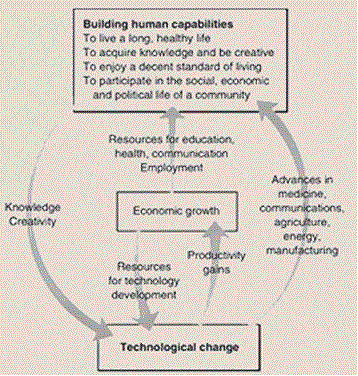
knowledge management and its purpose are captured by the United Nations Human
Development model.
United Nations Human Development model So,
where does ignorance come from? It’s quite simple, and quite obvious!
Ignorance is the lack of information or knowledge due to a lack of exposure
to it and/or an inability, through lack of interest or otherwise, to
understand and assimilate it. Everyone is ignorant in one way or another. For
example, if you haven’t studied medicine or engineering or any other
particular subject for that matter you will be ignorant in that regard. Part
knowledge and half-truths are dangerous, and more so when coupled with arrogance. There
is another way ignorance manifests itself and that is prejudice. This
particular characteristic blocks the mind and closes it to new knowledge. So,
how does prejudice develop? To answer this question, we need to go back in
time. Every
child that is born, discounting biological anomalies e.g. the 1% of the
population who are born psychopaths, have an equal chance in life. Besides
basic survival instincts, their brains are void of knowledge, but acquire, to
varying degree, knowledge and understanding in the first seven years of their
life. Their approach and behaviour are based on principles and values,
prejudices and preferences that are learned and become ingrained in their
subconscious, from parents, grandparents, siblings (if any), peers, society
and religion (if taught) in those first seven years. These characteristics
are carried throughout their adult life and will only change if their brains’
subconscious is reprogrammed. You are no different to any other person except
in your circumstances e.g. socioeconomic strata. However, we all grow up with
a quirk or two. These usually inhibit us in one way or another. But, being
able to identify our quirks (prejudices and weaknesses) we can do something
about these inhibiting little behavioural characteristics. If it was possible
for us to put a robot on mars, we surely can fix our quirks and soar to new
heights. What we need to do is open our minds to new knowledge and seek
truth. Back
in 1990, I went to university to do an MDP. On the course with me was a
journalist from the Sowetan newspaper and a farmer’s son from Pietersburg
(now Polokwane). Both had been raised by racist parents and were extremely
prejudiced toward one another and, at the beginning of the year, they were
always at each other’s throats, especially during law and economics classes.
But, by the end of the year they had become friends, albeit not always
agreeing with one another. What they discovered, having had to work with each
other on projects, was that the other was not so bad, or stupid, and they had
a positive contribution to make. And so, adjusting their subconscious minds,
they updated their thinking and got rid of their racist prejudices. So,
instead of focusing on attempting to fix other people, it is better for you
to open your mind and recognise your own red flags, which everyone has, and
heal yourself. When
you look at an iceberg, what you see above the water is only a fraction of
what is below the water. The same can be said of a human being. What you
observe as someone’s behaviour is what is manifest by what you don’t see. It
all begins with basic beliefs, values, attitudes, prejudices and perceptions
that a person holds, the foundation of which, as I have already said, were
developed in the first seven years of your life. It’s all embedded in your
subconscious mind.
The Iceberg
Principle Your
subconscious mind is for you and your body what an operating system is for
your computer. It runs everything, it stores your memories, beliefs and
habits, regenerates cells in your body, runs your heart, sending blood
through your veins and controls your immune system. It really runs everything
in your life. It controls over 97% of your behaviour!! To
change your behaviour, you need to change your basic beliefs – what you
believe is true. For this to happen it requires self-control, an open mind,
logical reasoning and a willingness to accept an alternate reality, if it is
proved true. A
wonderful example is the origin of Homo Sapiens. That’s us. This example also
highlights the problem of assumption, how theory evolves and, because of our
basic beliefs and locus of control, we believe a theory that is incomplete,
biologically impossible and mathematically simply does not add up. Typically,
we shut our minds to new knowledge because a learned person with a PhD
convincingly told you a story. So, the question is, if your university professor
says something that you discover and know is incorrect, would it be wrong to
question them? No, it would not! In
examining a theory (a supposition based on ideas intended to explain
something), and you find gaps in the theory, then it would be foolish to
believe the theory is true on account of it being incomplete. This
book is about two things, (accidental) evolution and (intelligent) creation.
So, let’s seek the truth, but know this, you will know truth when you see it. HOME | CONTENTS | NEXT CHAPTER |
||
|
|
|
||
|
|
© 2025 Copyright Tony Stone, South Africa |